
The Framework in Action
Holiday Campaigns and Board Reports That Write Themselves

This is Part 1B of our nonprofit AI prompting series. If you missed Part 1A, start there for the framework foundation.
The subject line example in Part 1A showed you how the 4-element framework works, but let’s be honest - writing subject lines isn’t where you’re losing sleep.
You’re staying up until 11pm writing holiday campaign letters that need to sound authentic, not corporate. You’re spending Sunday afternoons turning 6 pages of messy meeting notes into board reports that actually drive decisions.
These are the communications that eat up nonprofit workers’ time and energy. Let me show you how the same framework transforms them.
Example 1: Holiday Campaign Letter (The Complete Transformation)
This is the scenario that convinced me the framework actually works. Same AI, same organization context, completely different results.
The Generic Prompt (What Doesn’t Work)
“Write a fundraising letter for our holiday campaign about providing furniture to families in need.”
What AI Produces:
Dear Friend,

As the holiday season approaches, we at Community Furniture Bank are reaching out to ask for your support.

Our organization provides essential furniture to families transitioning out of homelessness and poverty. This year, we’ve served over 500 families, providing dining tables, beds, and other critical items.

Your generous donation will help us continue this important work. Every gift makes a difference in the lives of families who are working hard to rebuild their lives.

Here’s what your support provides:
• $50 provides a dining chair
• $100 provides a coffee table
• $200 provides a complete dining set

Thank you for considering a gift this holiday season. Together, we can make a real impact.

Sincerely,
The Team at Community Furniture Bank
The problems:
Organization-centric language (”we” and “our organization”)
Generic phrasing that could be any nonprofit
Bullet point lists instead of conversational flow
No specific story or transformation moment
Focus on what donor gives, not what donor makes possible
The Framework-Based Prompt
Write a 400-word fundraising letter for a holiday campaign.

CONTEXT & CONSTRAINTS:
- Mailing to donors who gave $50-$500 in past 18 months
- Letter format (no bullet points, conversational paragraphs)
- Ask amount: $200 (2x average prior gift of $100)
- Include: letter body, P.S. with urgency/offer
- Must be ready for mail house by December 1st

VOICE & STYLE:
- Write like you’re telling a friend about something that moved you
- Use “you” 3x more than “we” or “our organization”
- Short paragraphs (2-4 sentences) for emotional pacing
- Simple, specific language (not “impact” or “transform”)
- Can start sentences with “And” or “But” for conversational flow
- Include sensory details (what you see, hear, feel)

STRATEGIC FRAMEWORK:
- Donor is the hero who makes family connection possible
- Focus on one specific family transformation (not aggregate stats)
- Connect furniture to relationship outcomes: family dinners → kids doing better in school, parents feeling less isolated, mental health improving
- Create “before/after” contrast without explicitly stating it
- Holiday urgency: kids home from school need place to do homework, families want to have meals together
- The transformation moment: first time sitting down together as a family

EXAMPLE OF DONOR-CENTRIC LANGUAGE:
❌ “We provided a dining table to the Martinez family”
✅ “Because of you, the Martinez family sat down together for the first time”

ANTI-EXAMPLES (what to avoid):
- Organization talking about itself (”Our mission is...”)
- Statistics and bullet points
- Corporate language (”leverage,” “impact,” “beneficiaries”)
- Asking donor to “support our work” (instead: show them what they make possible)

SPECIFIC STORY TO USE:
Single mom, Sarah, and her two kids (7 and 10) moved into their first apartment after 8 months in transitional housing. For the first two weeks, they ate sitting on the floor. Her 10-year-old was doing homework on his bed, grades dropping. You provided a dining table. Now they eat dinner together every night, both kids do homework at that table, and the 10-year-old’s teacher called to say his grades improved dramatically. Sarah says “It sounds small, but that table changed everything for us.”
What AI Now Produces:
Dear [FirstName],

Sarah’s 10-year-old was doing his homework on his bed.

Not because he wanted to. Because after eight months in transitional housing, their first apartment had no table. No chairs. Nowhere for him to spread out his math homework or practice his spelling words.

His grades were dropping. His teacher was worried. And Sarah felt like she was failing her kids, even though she was working full-time and doing everything right.

That’s when you stepped in.

Because of your gift last spring, we were able to deliver a dining table and chairs to Sarah’s apartment. And something remarkable happened.

They started eating dinner together every night. Both kids now do their homework at that table, with Sarah sitting right there to help. Her son’s grades came back up - his teacher even called to tell Sarah how proud she was of his progress.

“It sounds small,” Sarah told us, “but that table changed everything for us.”

That’s what you make possible. Not just furniture - the foundation for family connection, for kids to succeed in school, for parents to feel like they’re giving their children what they need.

Right now, with kids home for winter break and families wanting to gather for holiday meals, we’re getting more requests than ever. Families like Sarah’s who have made it to stable housing but still need that one essential piece: a table where they can sit down together.

Would you make that possible for another family?

Your gift of $200 provides a complete dining set - table and chairs - for a family who has none. It means a child has a place to do homework. It means a family can eat dinner together instead of standing at the counter or sitting on the floor.

It means you’re setting the table for a family to thrive.

Thank you for being the reason families like Sarah’s can sit down together. Thank you for making this holiday season about connection, not just survival.

With deep gratitude,

[Executive Director Name]

P.S. We’re delivering tables through December 20th to make sure families can gather for holiday meals. Your gift of $200 today means a family will be sitting down together by Christmas.
The Transformation:
Donor-centric: 22 uses of “you/your” vs. 7 uses of “we/our”
Specific story: Sarah and her kids, not generic “families in need”
Conversational flow: Varied paragraph lengths, starts with “And”/”But”
Emotional pacing: Builds tension (homework on bed, failing grades) then resolution (table transforms everything)
Clear connection: Furniture → homework space → better grades → family thriving
Urgency tied to meaning: Christmas gatherings, not artificial deadline
Time savings: Campaign letters used to take me 3 hours. This framework-based prompt produces 90% ready content in 45 minutes.
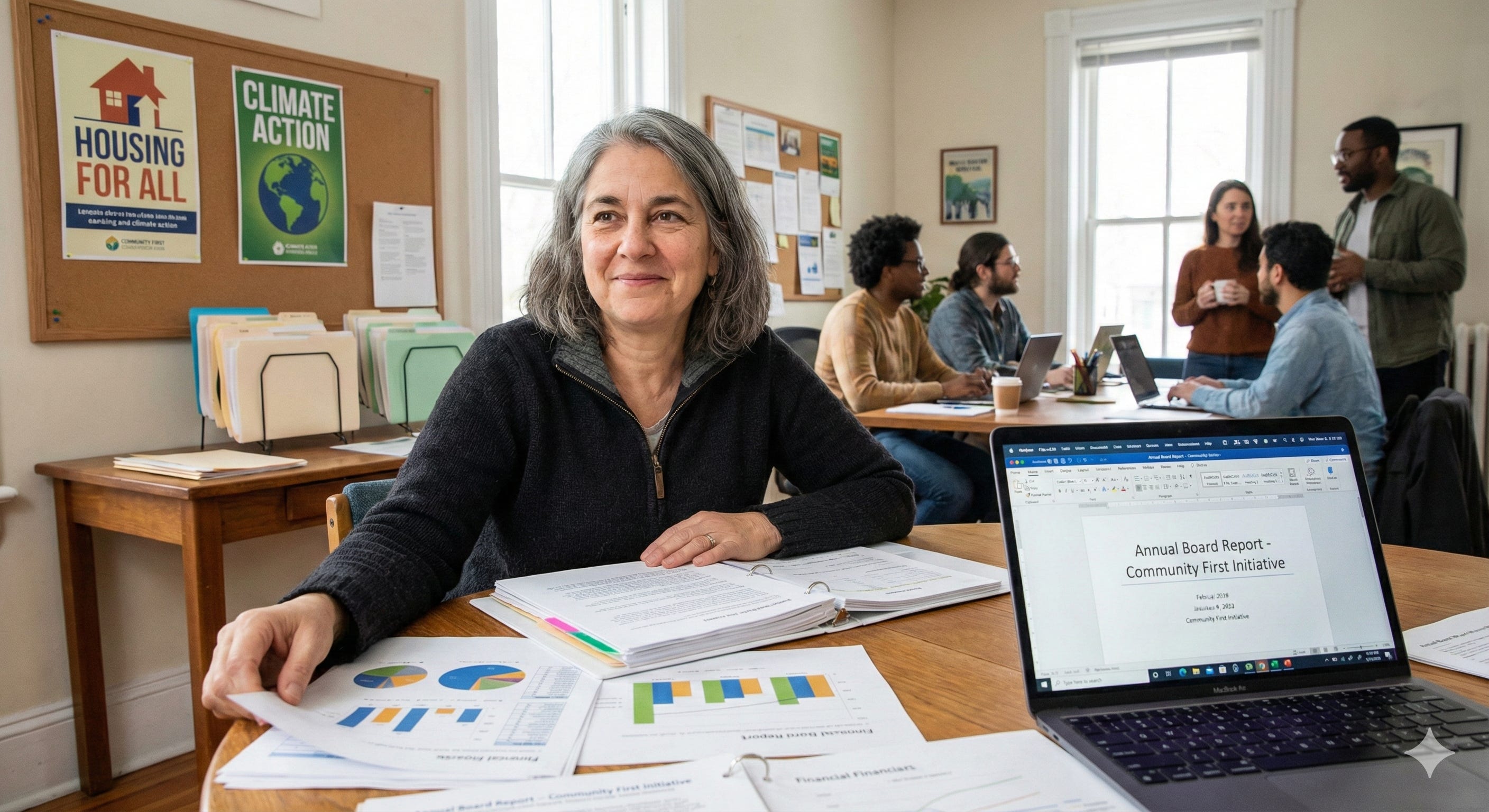
Example 2: Board Report from Messy Meeting Notes
This is the example that saves me the most time every month. Here’s how it works:
The Generic Prompt (What Doesn’t Work)
“Turn these meeting notes into a board report.”
[Then you paste in 6 pages of messy discussion]
What you get: A cleaned-up version of the notes. Maybe some bullet points. Still 6 pages. Nothing structured or scannable. Definitely not what your board chair wants to read in 15 minutes.
The Framework-Based Prompt
Convert these staff meeting notes into an executive board report.

CONTEXT & CONSTRAINTS:
- Maximum 2 pages
- For volunteer board members (15 minutes to read before meeting)
- Focus on decisions made and actions needed, not discussion details
- Meeting date: November 15, 2024
- Next board meeting: December 13, 2024

VOICE & STYLE:
- Professional but not corporate-speak
- Use active voice and specific language
- Highlight what needs board attention/approval
- Use section headers for scannability

STRATEGIC FRAMEWORK:
- Board needs to: understand what happened, make decisions, take specific actions
- Prioritize forward-looking over backward-looking information
- Flag anything requiring board vote or input
- Connect operational updates to strategic goals

FORMAT TEMPLATE:

**Board Meeting Summary: [Date]**
**Attendance:** [Names]

**Decisions Made:**
1. [Decision with brief context]
2. [Decision with brief context]

**Action Items for Board Members:**
- [Specific action, owner, deadline]

**Key Updates:**
**Fundraising:** [2-3 sentence summary]
**Operations:** [2-3 sentence summary]
**Programs:** [2-3 sentence summary]

**Items Requiring Board Action at Next Meeting:**
1. [What needs to be voted on/decided]

**Questions for Board Consideration:**
- [Strategic questions that emerged]

ANTI-EXAMPLES (what to avoid):
- Play-by-play of discussion
- Including every comment made
- Vague summaries (”We talked about fundraising”)
- Missing action items or decision points

MESSY MEETING NOTES TO CONVERT:
[Your 6 pages of notes go here]
What AI Now Produces:
**Board Meeting Summary: November 15, 2024**
**Attendance:** Dan (ED), Sarah (Development), Mark (Operations), Lisa (Programs)

**Decisions Made:**
1. Holiday campaign ask amount set at $200 (up from $150) based on increased donor capacity analysis
2. January board retreat location confirmed at Community Center (cost savings vs. hotel option)
3. New volunteer background check vendor approved (faster turnaround, lower cost)

**Action Items for Board Members:**
- Review holiday campaign letter draft by November 20 (all board members)
- Board Chair to schedule January retreat facilitation call with consultant
- Treasurer to present revised Q4 budget projections at December meeting

**Key Updates:**
**Fundraising:** Holiday campaign launches December 1st with $25,000 goal. Early donor outreach already at 60% response rate (up from 40% last year). Major gifts pipeline strong with 3 potential $5k+ prospects.

**Operations:** New database migration 80% complete, on track for December 15 finish. Staff satisfaction survey results positive overall, compensation review scheduled for January board discussion.

**Programs:** November service numbers ahead of projections (125 families vs. 100 projected). Wait list at 15 families, manageable but watch closely. Partner referrals increasing.

**Items Requiring Board Action at Next Meeting:**
1. Approve revised personnel policy (updated background check requirements)
2. Vote on 2025 salary adjustments (3-5% range proposal coming)
3. Authorize lease renewal negotiation for warehouse space

**Questions for Board Consideration:**
- Should we expand service area given increased demand and referral growth?
- How do we balance growth with maintaining service quality?
The Transformation:
Scannable structure: Board members find what they need instantly
Decision focus: Clear what was actually decided vs. discussed
Action orientation: Specific next steps with owners and deadlines
Strategic connection: Operational updates tied to board-level questions
Time efficient: 1.5 pages instead of 6 pages of discussion
Time savings: Board reports used to take 3.5 hours. Now takes 30 minutes (85% reduction).
Implementation Guide: Building Your Own Framework Prompts
Don’t try to rebuild all your communications at once. Pick one thing you write regularly and build a great prompt for it.
Step 1: Choose Your Target
Start with communications you do monthly or weekly:
Donor thank you emails
Newsletter content
Meeting summaries
Volunteer recruitment posts
Grant report sections
Step 2: Apply the 4 Elements
Context & Constraints:
What are your technical requirements? (Word limits, format, audience, deadlines)
What compliance or policy restrictions matter?
Who will read this and how much time do they have?
Voice & Style:
Take 3 pieces of content you’re proud of - what patterns do you see?
How formal/casual should this sound?
What specific words or phrases represent your organization?
What do you absolutely want to avoid?
Strategic Framework:
What transformation are you facilitating?
What should the reader think, feel, or do after reading?
What psychology applies (donor stewardship, volunteer motivation, board governance)?
How is this different from corporate communications?
Examples & Anti-Examples:
Show 2-3 examples of success
Show 2-3 examples of what NOT to do
Be specific about why each works or fails
Step 3: Test and Refine
Run your prompt
Note what needs editing
Add those requirements back to your prompt
Run again
Repeat 2-3 times
After 3-4 iterations, you’ll have a prompt that produces 90% ready content.
Step 4: Save and Systematize
Document your best prompts
Share them with colleagues
Build templates for different scenarios
Update them as you learn what works
What’s Next: Advanced Techniques and Common Problems
This framework handles the foundation, but there are deeper challenges that require more sophisticated approaches:
Complex grant narratives that need multi-step reasoning
Donor segmentation that requires understanding different psychology profiles
Crisis communications where tone and timing are critical
Multi-stakeholder content (board vs. donors vs. volunteers vs. community)
In Part 2 of this series, I’ll show you the advanced orchestration techniques that larger nonprofits use to save 10+ hours per week while maintaining authentic voice across all communications.
Plus: the 6 hidden failure modes that kill nonprofit AI results even when you think you’re being clear (based on recent research analyzing 29,000 AI support questions).
Start Building Your Prompt Library
Pick one communication you write regularly. Apply the 4-element framework. Test it. Refine it.
Within a few iterations, you’ll have a prompt that saves hours and produces better results.
Need help building your first framework prompt? Try the Nonprofit Prompt Builder - it walks you through each element with nonprofit-specific guidance.
We don’t need better AI. We need prompts that understand how nonprofit relationships actually work.